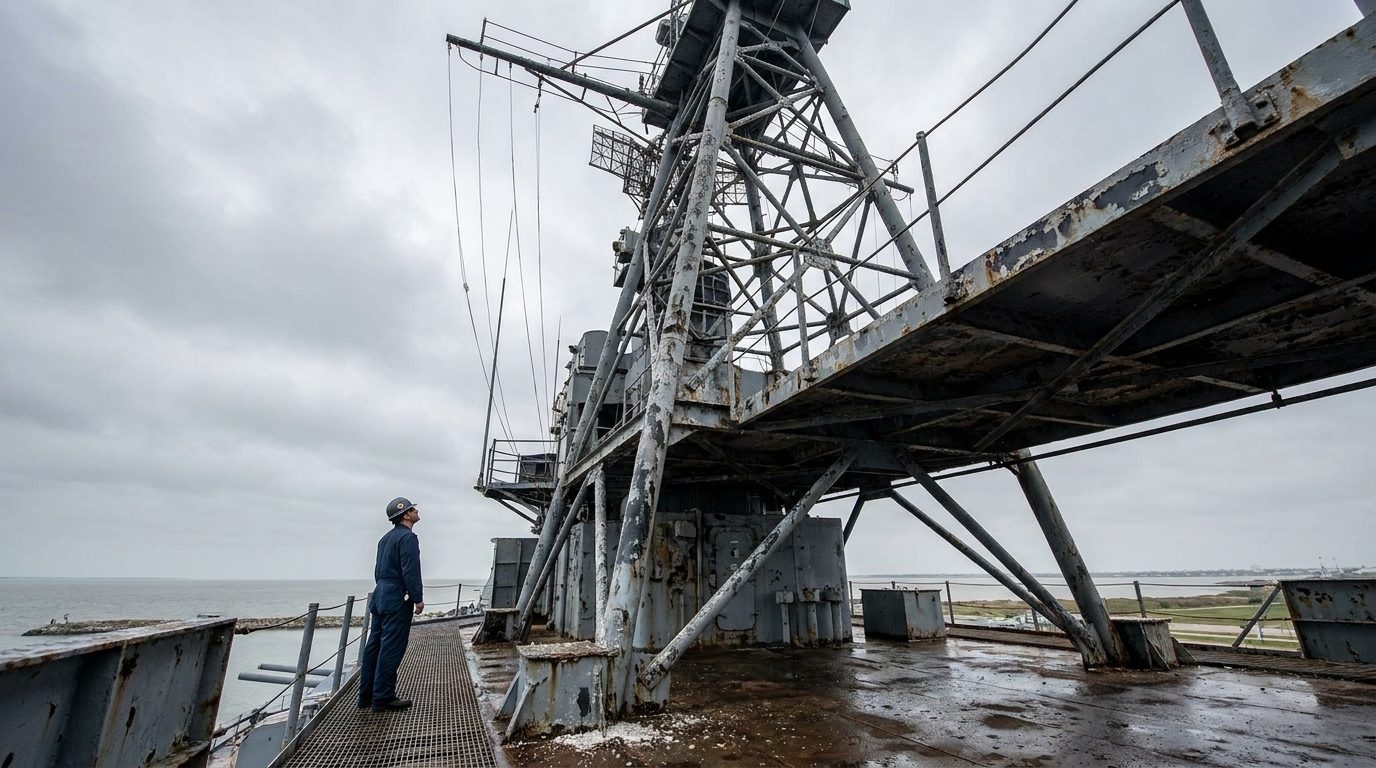
How early radar changed the battles on the USS Texas BB 35
The Texas was commissioned in 1914. She is a museum ship now, and she is the only surviving American battleship that served in both world wars, which makes her a useful place to see what thirty years of technology did to one hull.
The most important thing that happened to her was not a bigger gun. It was an aerial.
What gunnery was before
A battleship's main battery could throw a shell far beyond the horizon. Hitting anything at that distance was another matter entirely.
The method was optical. Spotters high in the masts, rangefinders with long baselines, and a fire control system that took bearing and range, estimated the target's course and speed, and computed where to put the shells. Then you fired, watched the splashes, and corrected.
It worked, and by the 1930s it worked remarkably well in good conditions.
The conditions were the problem. Fog, rain, smoke and darkness took your eyes away and left you with nothing. Night surface actions before radar were close range, confused and frequently decided by whoever saw the other side first.
What arrived
Texas received CXAM radar, one of the early American sets, around 1941. She is often cited as one of the first American ships fitted with it.
Air search radar first. That is the one that changes fleet life immediately, because it turns air defence from a matter of lookouts and luck into something you can prepare for. Knowing that aircraft are inbound, roughly how many and from what bearing, twenty minutes before you can see them is an enormous change.
Then fire control radar, which is the one that changes gunnery. A set that ranges on the target directly, in the dark, through weather, and feeds that range into the fire control system.
Later in the war she also carried sets for surface search and for fighter direction, and the structure of her masts changed repeatedly to carry them.
What it meant in practice
Two things, in my view.
It made shore bombardment far more accurate, and shore bombardment is what Texas mostly did in the second world war. She was off Normandy in June 1944, off southern France, and later at Iwo Jima and Okinawa.
Bombardment is a different problem from ship to ship gunnery. The target does not move, but you do, and you need to know precisely where you are relative to a point on land you may not be able to see. Radar ranging on known coastal features solved a great deal of that.
And it removed the night as a hiding place. For a generation of officers who had trained for night action as a matter of nerve and short range, that was a profound shift, and the ones who adapted fastest did very well out of it.
What it did to the ship
Radar sets are heavy and they go high up, which is the worst place for weight on a ship that already has stability constraints.
Every set added meant compensating somewhere. The masts were rebuilt. The bridge structure grew. The old cage masts of the first world war era gave way to tripods and then to heavier structures carrying platforms and aerials.
Radar also brought a new kind of sailor aboard. Technicians who maintained electronics, in spaces that had not existed a few years earlier, doing work that nobody on the ship in 1918 could have described.
A note on claims
There is a lot of loose writing about which ship had radar first and which action was the first radar controlled engagement. The records are more tangled than the confident sentences suggest, sets were fitted and modified continuously, and a number of firsts depend on how you define the term.
Texas was among the early ships fitted, and that is a claim I am comfortable with. Beyond that I would be careful.
Seeing it
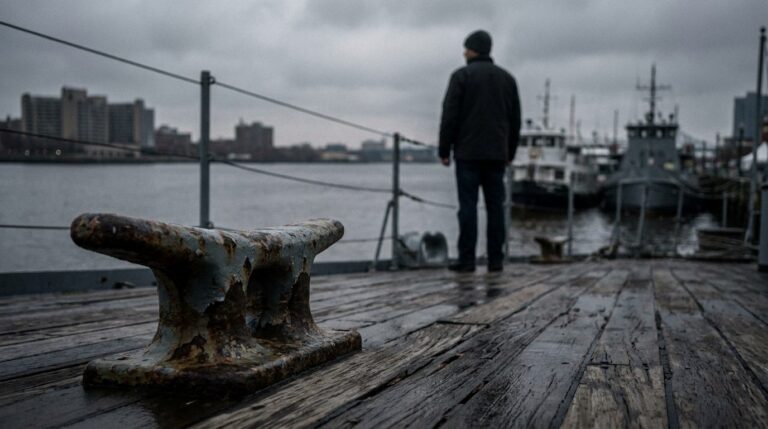
She is at La Porte, Texas, and she has been through a major hull restoration in recent years, which she badly needed.
Look up. The mast structures are the part of the ship that tells the story, because the hull below is essentially 1914 and the top is 1945. That contrast on one vessel is the whole point of visiting her.
Her hull number is BB-35. The New York class comprised two ships, Texas and New York, BB-34.