
Why so many second world war deck logs never made it to the archives
People write to the National Archives expecting to find a day by day record of a relative's ship and are told the record does not exist. That answer is usually correct, and it is worth understanding why, because the reasons are more varied than most people assume.
A deck log is the official running record of a ship. Watch by watch, in a bound book, kept by the officer of the deck. Course and speed, weather, ships in company, personnel movements, and anything that happened.
They are extraordinary documents when they survive. They are also a great deal duller than people expect, and they are not a diary.
The obvious reason
A ship that sinks takes her logs with her.
The current book is on the bridge or in the chart house, which is not a survivable location on a ship that goes down quickly. Earlier volumes are stowed below.
Crews abandoning ship do not carry ledgers. That is not a criticism, it is a statement of what abandoning ship is like.
So for a lost ship you are generally looking at the reconstruction rather than the record: action reports written afterwards from memory by surviving officers, war diaries held elsewhere, and survivor statements. Those are real sources and they are often very good. They are not the log.
The less obvious reasons
Volume. The wartime Navy was enormous and it generated paper at a rate that nobody had planned for. Retention decisions were made under pressure, by people who were not archivists, about material whose historical value was not obvious at the time.
Physical damage. Logs that survived a fire or a flooded compartment did not necessarily survive in readable condition. Paper that has been soaked and dried is fragile and ink runs.
Transfer losses. Records moved between commands, storage depots and eventually the Archives, and things went astray at every step. A crate misrouted in 1946 is not recoverable.
Small craft. Landing craft, patrol boats, auxiliaries and the like often kept less formal records or none that were retained centrally. If your relative served on a landing craft, the chances are poorer than for a destroyer.
There is also a widely repeated story about a fire destroying military records. That fire, in 1973, was at a personnel records centre and it primarily affected Army and Air Force service records. It is frequently blamed for gaps in naval ship records, which is not what it did. The confusion is understandable and it sends people down the wrong path.
What usually does survive
War diaries, which are a monthly narrative summary and often more useful to a family than a log would be.
Action reports, written after any significant engagement, sometimes in considerable detail.
Muster rolls and reports of changes, which establish who was aboard and when. For genealogy this is frequently the document people actually need.
Ship histories compiled by the Naval History and Heritage Command, which are free online and a sensible first stop.
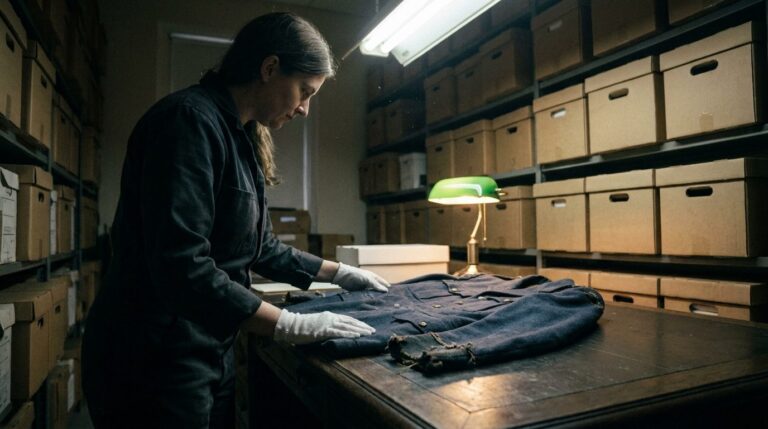
Deck logs for ships that survived the war are held by the National Archives and a great many of them do exist. Availability varies by year and by ship and some have been digitised.
How to ask
Be precise. Full name of the ship, hull number, and the date range you want. A request for the USS Wasp without a hull number is ambiguous and will take longer to answer.
Start with the ship history and the war diary. Go to the deck log when you have a specific date and a specific question, because reading a year of logs to find one event is a serious undertaking.
And accept that some of it is simply gone. I have had to tell people that about their fathers' ships and there is no good way to say it. The absence is not carelessness on anyone's part now. It is what happens when a very large navy fights a very large war and then demobilises in eighteen months.