How the USS Laffey DD 724 survived Okinawa
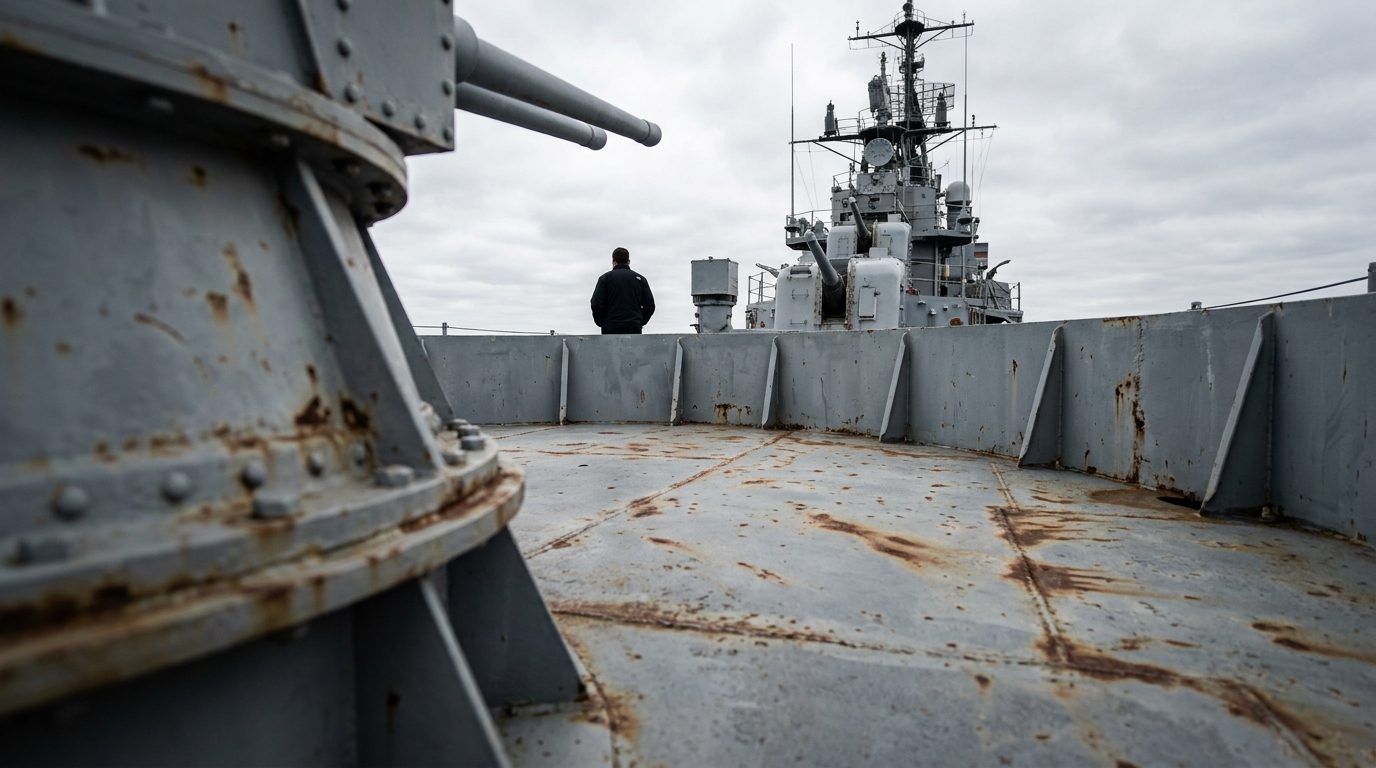
You can walk her deck today. She is tied up at Patriots Point in Charleston, and if you go, stand at the after gun mount and look forward, because that is roughly where the worst of it happened on 16 April 1945.
The Laffey was an Allen M. Sumner class destroyer, commissioned in February 1944. She had already been off Normandy. By the spring of 1945 she was at Okinawa on radar picket duty, which is the assignment nobody wanted.
What radar picket duty actually was
The invasion fleet lay off Okinawa in an enormous concentration of ships. To give that fleet warning of incoming aircraft, destroyers were stationed out on a ring of numbered stations, well away from everyone else.
A picket destroyer was there to be found. That was the job. You sat out on the perimeter with your radar turning, you called the raid in, and you directed the fighters onto it.
The Japanese understood the arrangement perfectly well, and the pickets took a beating all through that campaign that is out of proportion to the number of ships involved.
The morning of 16 April
Laffey was on Radar Picket Station One, north of Okinawa. The attack came in waves and it did not let up for about eighty minutes.
The accounts agree on the general shape of it and differ a little on the exact tally, which is normal for an action of that intensity. The figure usually given is twenty-two aircraft attacking her, with six kamikaze strikes and four bomb hits.
The rudder jammed. Fires burned aft. Two of the after gun mounts were wrecked and the crews in them were killed. Her after section was, by the end, a ruin.
She did not sink and she did not stop shooting.
Why she stayed afloat
Three things, in my judgement, and reasonable people could weight them differently.
First, the hits came aft. The engineering spaces amidships stayed intact, which meant she kept power, and power means pumps. A ship with pumps and a crew willing to use them can absorb a great deal.
Second, damage control was excellent and it was practised. That is not a compliment people hand out lightly. Wartime American destroyer crews drilled damage control constantly and the payoff shows up exactly here, in the hour after everything goes wrong.
Third, she had help. Fighters were vectored in, and other ships came to her. A picket alone against that many aircraft would not have lasted.
I would add a fourth that is harder to write about. A crew that decides a ship is finished usually turns out to be right. That crew did not decide that.
What it cost
Thirty-two of her men were killed and something over seventy wounded. On a destroyer with a complement of around three hundred and fifty, that is a third of the ship's company.
She was patched at Okinawa, taken to Guam, and then to Seattle for real repairs. The war ended before she came back.
Her captain, F. Julian Becton, remained associated with the ship for the rest of his life, and the phrase that stuck to her, the ship that would not die, came out of that period.
What I would say about the nickname
I am wary of nicknames. They flatten things.
The Laffey survived and a great many picket destroyers did not. Ships were lost on that line with crews every bit as good. The difference between the ones that came home and the ones that did not was often the angle a particular aircraft came in at, or which compartment a bomb reached, and calling one of them indestructible does a quiet disservice to the others.
What she does demonstrate, and this is worth taking seriously, is how much punishment a well built warship with a trained crew could absorb.
If you go
She is open as a museum ship and the after section has been kept in a way that shows what happened. Take your time back there.
Get the hull number right if you talk about her, because there have been several Laffeys. This one is DD-724. The first, DD-459, was sunk off Guadalcanal in November 1942, and confusing the two is the most common error I see, including in print.
And the men are listed. Read the list. It is short enough to read and long enough to mean something.